Get your own Modular Wargaming and RPG Terrain System at our E-shop!
Showing posts with label tiles. Show all posts

2017/02/09

Journal #15 - Going Urban!

Welcome to our first major 2017 Blog update, presenting the details of our next project, the Pedion Urban Battlefields!

For those of you already keeping in touch with this page, this is something you must have been expecting, as it was announced in the previous blog post and all over social media. The Urban Battlefields are to be the first major expansion of our Modular Battlefields line, a comprehensive selection of options to stage village/town/city encounters and battles. It includes enough textures, ideas and designs, to go beyond another "unlock" of our existing line, and qualify for a full campaign on Kickstarter of its own.

Ready for some Pedion street fights?


What will the new tiles do?

I will start by stating the design principles behind the Urban Battlefields; the tiles should:

  1. allow the gamer to quickly recreate street networks and the chaotic fabric of an urban environment in multiple configurations, different for each game.
  2. look beautiful and authentic, but at the same time be practical for gaming.
  3. work with other Pedion Battlefields tiles.
  4. enable the placement of buildings, fences and terrain scenic details in general from any manufacturer, without stealing the spotlight. 
  5. adhere to all Pedion design parameters: full molecularity, simple connectivity, thin, low weight, durability, easy storage. 

Have you thought about Buildings, Scale, Textures?

There are several issues that one must take into account when producing the layout of urban tiles, which were not so acute in our open space tiles:

  • Their textures and styles immediately limit the historical/fantastical eras they can be used for (e.g. an asphalt road rules out any non 20th+ century era gaming). 
  • Their width restricts their playability in different miniatures scales. This becomes quite more pronounced when there are road lines, which should be in scale.
  • They look a bit drab without any actual urban features upon them, i.e. they look out of place without buildings, since till that time all you see is an unexplained open space crisscrossed with roads.

Regarding those last 3 issues, I've gone along and made some basic decisions.

Starting from the third one, this expansion will not have anything to do with man made structures. There are many manufacturers of beautiful houses and buildings out there, and I hope they will not mind using their gorgeous products for some photoshoots in order to show off how the tiles would look on your table. Pedion is all about bringing to you stuff that it's not already on the market, and the market has lots of buildings. We have ideas on fully modular constructs, but this will be a specialised, later effort.

On the issue of scale, we will continue with our previous selection of 7cm (2.75 inches) for the roads' width. This particular width has been successfully tested on the Modular Battlefields so far, and it "plays" fine, from 15mm to 28mm scales. For the mathematically oriented, these 7cm represent a 7 meter wide road in 15mm (2 lane road) or a 4 meter wide road (1 lane) in 28mm. And there is nothing stopping you using a 7cm road as a highway in 10mm urban gaming (e.g. Dropzone). Finally, the new tiles could this way be connected with minimum fuss with roads on our current line. Therefore, we will be going with 7cm width for a universal effect, and perhaps unlock wider roads if there is respective demand during the campaign.

Road scale - Does my Tank fit?

My only issue are the road lines and markings on modern, asphalt urban environs. Especially dividing lines, which automatically designate road lanes and therefore vehicle size (and thus, gaming scale). This is something we cannot easily avoid, so it will be up to the backer to decide if he/she wants lines to show on the asphalt and what scale to be implied. Designing the road lines will be an added service, to be done in the way each customer wants it.

Finally, the selected Themes. Trying to encompass the look and feel of every urban corner in every era and genre can be quite impossible. Even more, Pedion is intended for gaming, not for dioramas (however good it may look). So, from all the options, I concluded on three (3) generalised urban terrain Styles, feeling that they could cover multiple periods and that the buildings placed on them would do the job of specialising the board's historical/geographical/genre purpose.

The Rustic Style: Dirt/Cobblestone combination

The first Style available will combine classic cobblestone roads with a "dirt"/soil texture on non-paved areas, i.e. the spaces reserved for buildings. The soil texture is broken with patches of green vegetation, and there are extensive grass tufts on the road sides, where the water usually collects. The dirt coloration is a not one used in our tiles before, but completely new, intended to be more neutral for any geographic location.

The style works quite well on on Urban/suburban environment where the people may have used cobbles to pave some of their streets. It fits Rustic settlements, rural areas, villages, small Towns, even ancient cities if the residing civilization used stone on roads. By leaving open spaces in-between the houses, one can create smaller alleys and dirt paths branching away from the main cobblestone roads. There are no signs of a drainage system, so that the Style can be used in areas and eras where an underground one would not exist.

In the following photos you can see the Style used on a 3'x3' configuration of 9 tiles, with and without buildings and miniatures.

The intended 3'x3' Pedion Urban Set, Rustic Version

The exact same board, now populated with buildings, miniatures, scenery and vehicles,
turned into a European Village during WWII for a game of Bolt Action

Or... how about a fantasy Village, with some Goblin Raiders?

The Medieval Style: Cobblestone combination

Perhaps the more robust Style, as it can be used in many a Wargame or RPG scenario. The style uses two different cobblestone patterns, a smaller, recessed one for the roads, and a larger, embossed one for the building spaces. There is an irregularly shaped string of stones on roadsides to act as a primitive sidewalk, and there are drainage grates implying the existence of basic sewers.

The Style can be used to represent the basis of multiple urban environments, especially medieval areas, fantasy settlements, and many European City Centres up to the present day!

The following snapshots give an example of the Medieval Style, with and without extra stuff on it.

The contents of a 3'x3' Pedion Urban Set, Medieval version

The same board, now with greenery, buildings, fences and entrenched German troops!


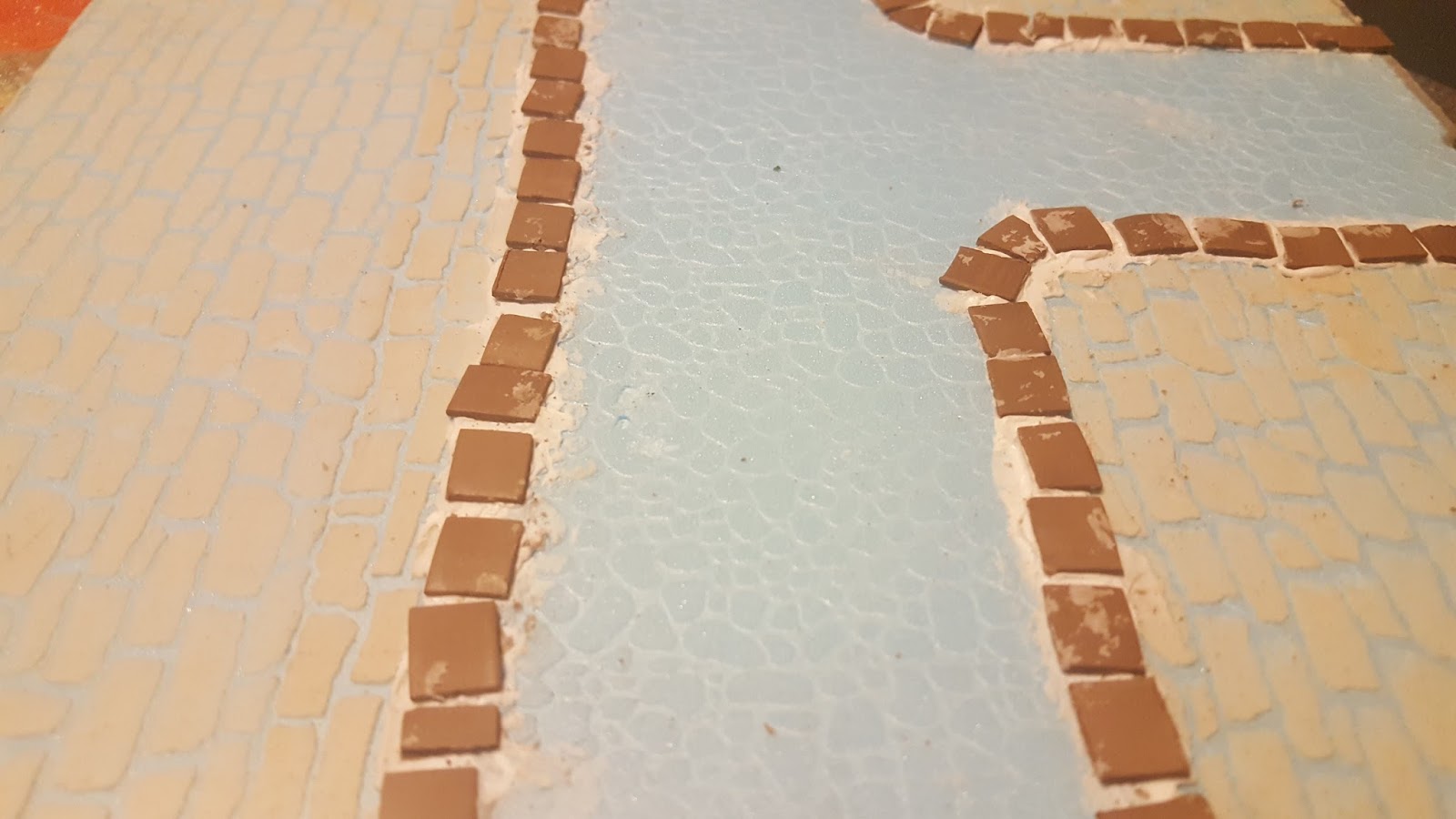
and a view under the hood: how the Medieval styled tiles look before painting:


The Modern Style: Paved stone/Asphalt combination

For those gaming in the modern (or futuristic) era, I've designed a Style where the road surface is asphalt, the open areas are paved with large geometric stones, and there are proper pedestrian sidewalks. There are again drainage facilities, like manhole covers. The sidewalks protrude 1mm from road level and they are 2.5cm (1") wide.
As mentioned above, road lines are possible but may limit the option of playing in different scales. Greater road width will probably be an option during the Kickstarter.


The contents of a 2'x2' Pedion Urban Set, Modern Version

A Street fight on the board above


Why the Kickstarter?

The main reason for a running a KS campaign for this expansion is actually the same as for our previous one: we want to gauge if people like the idea behind those tiles, so that we can iron out all the details and schedule up a full production. By running a KS campaign we will be able to find out toward what designs do gamers lean, and flesh out specific ideas and new designs with our supporters. This will not be a simple "preorder" phase, but a chance to bring people to our drawing board, months before we start actual production.

What about the Kickstarter which is still fulfilled?

The newer campaign will by no means affect or influence the current production and fulfillment of the much more complex previous Modular Battlefields campaign. The new KS will pertain to a production which will start months later, with a different design, and under its own production team and personnel. Even more, the Urban tiles will be designed to be more straightforward production-wise, to act as a separate, streamlined line.


When will the KS Campaign start?

Quite soon! The plan is to have the campaign ready and be able to launch before the end of this month, February 2017. The sooner we start the sooner we will be able to go full throttle after finishing all current fulfillment. There will be one more Blog post to give more details on the Campaign, as well as to discuss various ideas and expansions on the 3 basic Urban Styles. There you will find out more on add-ons, unlocks, stretch goals and how the Urban tiles will work with the current .Pedion Sets. But you can keep in touch and learn about any news if you follow us on our facebook page and/or our twitter account!


Hope you enjoyed reading all about our new stuff! Get ready for the Kickstarter!

George

2016/11/21

Journal #14 - Reviewing and Moving on!

"Really impressive work ! Great packaging !" (P., Hong Kong)
"Top notch product - I'll be ordering more!" (N.A., USA)
"The opening of Awesome" (M.S., USA)
"The tiles are exactly what I had hoped for" (G.Q., UK)
"The pieces are fabulous and better than I could have hoped. Well worth the money and then some!" (A.L., USA)
"I am in absolute rapture with it. [...] It is worth the wait" (B.W., USA)
"Is the Pedion Battlefield system the best thing to ever come out of the Hellenic Republic? Probably yes" (B.W., UK)
"F@@@ing Awesome!" (S.N., NOR)

Wow, it has been a long time since an update in this Blog. I am constantly working, creating more and more Terrain for the Kickstarter backers and the rest of Pedion clients. And what a response! However, I wanted to take a short break and share some thoughts on how Pedion has fared, as well as about the things that are in the works.

Like what you see? read on..


The -very- Good

All in all, I do count the whole venture as a success. After less than a year and a half from running the Kickstarter, Pedion has been established as an terrain and scenics provider in the world of tabletop gaming. The final product meets and even exceeds expectations, as it is evident by the comments of people receiving it - some of which I included above. I think it says a lot when people get their stuff and place orders for more, even if they know they have to wait. But the real success lies in how happy this whole effort has made me, been in contact with so many folks who really enjoy my hard work, many of whom I have ended up to call friends!

I feel that Pedion is earning its place at the niche of the gaming industry, as a high-end terrain product, a modular solution for when you want something looking good without affecting gameplay, robust, modular and easily stored away - and you don't have the time and/or aptitude for making it yourself. In terms of affordability, I strongly believe that while the prices are not very low, they are more than fair. The amount of work involved and the attention to detail and quality we try to pay to each handcrafted set is excessive, and may not be fully reflected in the price.

The -not so- Bad

While things are going well, it does not mean they run smoothly or as we had planned. The greatest issue are the delays in delivering orders, which actually derive from initial optimistic calculations on production times and costs. And yes, there is also the serious issue of extreme cash devaluation due to Brexit, but disasters happen, and I'll not throw the towel for something like this. What matters is make things even better.

Do not get me wrong; we started delivering before the promised deadline, and not many Kickstarters have almost finished with pledges 1.5 year later. But we are still delivering, we work overtime, costs pile up. The main lesson (production-wise) I have had to digest was that our terrain is still a hand-crafted, detail oriented product, and thus it needs extra time. It is not a mass produced book sent to a printer, or a series of miniatures cast overseas; the whole process is run in-house. And I want to keep it this way, for I have yet to find a better way to keep the quality and service at the high standards we have achieved.

The silver lining is that we have improved our techniques, based on our experiences so far. We strive to hit the sweet spot where we apply standardized methods (construction, casting, assembly, base painting) to achieve uniform quality and faster production, while still having to work by hand and treat each tile uniquely, like a small work of art. I believe that now we are finally achieving this, and so can make more solid future plans.

What is Coming!

I feel that we have -at last- reached a spot where Pedion can expand even more. While the production of all previous orders continues full throttle, we plan for a series of new products, complementing our existing line. As I have stated before, it is not the intention of Pedion terrain to try and compete with established terrain companies by offering similar products, if only pre-painted. On the contrary, we will implement designs which will literary bring something new to your table.

The new lines will uphold the main Pedion principles, as stated about two years ago in the very first article here: full modularity, multiple different configurations, assembled /disassembled in seconds, beautifully handpainted, stored in minimum spaces, lightweight and durable. Also, they will "work" with present and future products.

Taking into account the lessons learned by our first Kickstarter, production will now be handled in a more focused way. There will not be a huge Kickstarter like the one before, where lots of themes, styles, designs and options were unlocked and made available (driving us crazy trying to handle all requests). On the contrary, there will be multiple, focused campaigns, each for a specific series of products. This way we will be able to focus production on certain items, deliver and move on.

So, what's to come?

1. First Expansion - the Pedion Urban Range

We will start with expanding and standardizing our existing product line of "Urban" Tiles. While people can already order tiles with road configurations unlocked during the Kickstarter, our next project will take this a step further.
We want to present full 2'x3', 3'x3' and 4'x4 Sets of tiles where you can configure your roads in any way and use them as a beautiful background for Buildings. People can already "create" such sets by combining road and tile textures of our Modular Battlefields. However, these have a more "outdoors" look and feel, so we will introduce four (4) specific Themes for Urban environments:

  • Cobblestone Roads with Dirt Open Spaces 
  • Cobblestone Roads with Cobbled Open Spaces (a mostly Fantasy/Medieval/European theme)
  • Asphalt Roads with Pavements and Cobbled Open Spaces (a Modern theme)
  • Hex Roads with Hex Open Spaces (a Sci-Fi theme)


Example of the intended Cobblestone Roads/Dirt Spaces Urban design (3'x3' Set, W.I.P.)

Same 3'x3' Set, with added scenics to give context; a beautiful rural town materializing
(Paper buildings from the Fat Dragon and Dave Graham ranges, Miniatures painted by Anne Yeomans)


During the campaign, we hope to unlock variant urban designs like town squares, road roundabouts and parking places. Another unlock would be different elevation options, with slopes, uphill roads, steps... and there are even some thoughts on town docks... Finally, we want to introduce as part of this campaign, special "transition" tiles, which will allow you to combine two different themes n the same table, or pair your older Sets with the Urban ones.

This will be the first new Kickstarter campaign,and it will be sooner than you think - we aim for early January 2017 so stay tuned!

2. Second Expansion - the Pedion Indoors Range

This will be Pedion's approach to a Dungeon System. Do we need another one? In my mind yes, if it is not copying the excellent Dwarven Forge designs but strives to cover different needs. Keeping this in mind, we designed a system of interconnecting walls and floors in true Pedion spirit.

Our usual tiles will be the floors, textured and hand painted, at 30cm x 30cm squares. And your walls will allow any kind of design you like.
This Range will follow (and enrich the Urban range) and it is past the design phase, as we have created a number of moulds already.

An early prototype for the basic Set


3. Third Expansion - the Beach Landings Range

This is a more "boutique" expansion for our current Battlefields range. It aims to introduce a full trenches and fortification series of tiles, along with full solutions of Sets recreating WWI and WWII landing sites. The range is intended to combine existing designs (our excellent coastlines) with new ones (high rises, earthworks) for people who want to represent Normandy or Pacific Island engagements.
This Range is still in design phase, although I have begun setting up the first D-Day prototypes!


This is all for now. I hope that I have (re)kindled your interest and that you will accompany me and Pedion in the great things to come!

Good gaming,
George


2015/06/26

Last Four Days to get your PEDION Modular Terrain!

It seems that after hitting the infamous "mid-campaign" sluggishness, the Pedion Kickstarter campaign managed to reach the £25000 pledge sum, unlocking the Pond/OxbowLake/Marsh Tiles.
Now, it is the last four (4) days of the campaign - for Pedion's to become even better and for you to get an even greater variety of battlefields. So, if you were planing on pledging, now is the time!
While Pedion will be available through our e-shop after the Kickstarter is fulfilled (this is the project's aim after all), backers will

  1. pay less that the retail prices, both for tile sets and for the subscription service
  2. get free stuff like trees, walls etc
  3. receive their sets much sooner
  4. help Pedion become even better.

Even if you think about getting lots of terrain afterwards, a pledge now can mean wonders for Pedion's future. And speaking of future, let's take a look at those Stretch Goals!


Pond and Widening River Tile, with Marsh Upgrade

The £25000 Stretch Goal unlocked a series of tiles and upgrades, which actually are based on the same base design, and their production will use the same mold. The two tile types are the Pond (small lake) Tile and the Widening River Tile; both tiles can be converted to include marshland!

The River Widening is a special river tile (a river Turn, joining to the rest of your river tiles) which meanders and the water is in the process of creating an oxbow lake.


Widening turn river tile (forming an Oxbow lake), painted version
The Pond tile is actually a stand-alone small lake, using exactly the same design without the river connections (thus saving some £ on mold design)


Pond Tile, painted version
What really makes the difference though, is that you can at anytime convert those two tiles into marshland! With the corresponding add-on, you can clip on and off swamp surface, creating either a partial marshland on a river side, or a full marsh on top of your lake:


Widening turn with prototype* Marshland add-on clipped on, turning the tile into a riverside marshland**


Pont tile with a Marshland prototype* add-on, turned into a full Swamp


Close view on the riverside marshland
*Expect the final Marshland add-ons to be made from much thinner resin, in order to fit more seamlessly on the river/lake sides, to reduce slopes and to keep the whole marsh on a lower elevation.
**The marshland motif has been drawn from Luisiana marshland images. The riverside marshland is formed at the wider side of the river. This is not common, since water flows faster outside, but it made for a bigger marsh; so let's assume that the outer curve would be the place with lots of alluvial which would help to create a marsh if the water would again erode the closer turn...

Next Stretch Goal: SciFi Themes and Crater Tile types

Although we are nearing the end, there is a number of Stretch Goals that we may unlock yet! 
The closest one, on terms of pledge total, is the availability of two new ground variations when we reach £28000, both more suitable to a Science Fiction setting: the "Red Planet" and the "Grey Wastes". These new variations will also unlock a new type of Tile: the Crater tile.
Actually, there are going to be two different kinds of crater tiles. The first is going to show a big, regular crater, usually the result of planetary Impact. The other will depict overlapping smaller craters, with ground devastated from artillery. Take a first glimpse of both the new themes and the crater tiles on the photos below:
Impact Crater Tile, Red Planet Theme

Impact Crater Tile, Red Planet Theme with 15mm SciFi minis

Artillery Crater Tile, Grey Wastes Theme


Artillery Crater Tile, Grey Wastes Theme, 15mm SciFi minis

Next Social Stretch Goal: FREE Walls for everyone if we reach 165 Backers

Since the number of 180 backers may seem a bit far-fetched, I do not want to end without another freebie :) So, let us reach 165 Backers first, and everyone with a physical reward will also receive some free walls! Specifically:
  • For every backer who gets 1 to 6 tiles (through Sets and add-ons), he or she will receive 1 Hedge Fences Set (that's 2x 12cm or 4x 5.2cm Hedge walls, see add-ons)
  • For every backer who gets 7 to 16 tiles (through Sets and add-ons), he or she will receive 1 Stone Walls Set (that's 2x 12cm or 4x 5.2cm Stone walls, see add-ons)
  • For every backer who gets 17 or more tiles (through Sets and add-ons), he or she will receive 1 Magnetic Columns Set (that's 2x single connectors and 1 T-connector columns, see add-ons)
  • All Wall System Starter Sets get ONE MORE Stone Wall piece

Future stuff...

We may never reach it, at least on this Kickstarter, but I wanted to give you a glimpse of what I had in stock for the SciFi/Urban Stretch Goal: a road tile upgrade with luminated roadsides... Check the early prototype - LED lighting on 12V Battery


So what are you waiting for? The time is now - pledge, spread the word, bring your friends in and get the last terrain you will ever need!

Good gaming,

George


2015/02/06

Journal #3 - or, Choosing materials for Pedion Modular Terrain Tiles

Here I am, back to my blog, to ramble on about the materials I will use on Pedion tiles. I know, I know; the last blog post was not too impressive, lots of talk, and no "real" terrain progress showing. But it was an important part of developing Pedion, and I feel I should share it with anyone interested. However, I WILL try to by "less text wall, more to the point" in this third blog post, to make it an easier read.

So, as finalized in my previous (#2) post, I decided to go with Square tiles, each measuring 30x30x1(thickness) cm. The next step was to decide a) which materials to use and b) how to keep the modules connected to each other - both points I will be tackling here.

Choice of Materials

Before describing my process, let me remind  -once more- my Requirements which apply to the Tiles, as presented in post #1ModularityEfficient Storage, Lightweight, Economical, Durable, Appearance, Level surfaced, Seamless and Connectivity - all these under the perspective of mass producing Pedion, not just making a home-brewed terrain table.

Most of these Requirement play a major part in selecting construction materials. Efficient Storage is quite covered by the selected tile size and depth. Seamless and Connectivity we will cover further below. All the others are crucial, especially the difficult combination of Lightweight/Durability/Economy! Also, regarding Appearance: I wanted the Pedion tiles to be made from something to allow me to work with and create depressions on the terrain. That meant that a simple, hard basing material was not enough, but a more malleable material (like foam) was needed.

My first effort, as shown in the pictures, was the use of Foam Board, also known as Foam Core, the material most Architects use for modeling (told you I'm an engineer, didn't I?). For those of you who have not heard of it, it's a combination of solid foam sandwiched between two layers of strong cardboard (we call it "maquette paper" in Greece). I used 1 cm thick foamboard (about 0.4 of an inch) and cut it into my 30x30cm (~1x1ft) squares. Foamboard has a variety of great advantages: it is strong, yet extremely lightweight. It can be cut by normal craft tools, like a hobby knife, although it requires a proper method to do so (watch Mel's great video tutorial). And it combines the rigid cardboard with the foam in its core, so I could just "dig" into the stuff and create anything I wanted (up to 1 cm deep), and still have a base underneath. It also allowed me to keep a small (2-3 mm) cardboard "edge" on each tile, so they could overlap and cover the seams a bit. Finally, while not as cheap as pure foam sheets, it is not to expensive either (even at the 1 cm thickness) so I could keep the project cost low.

That's aprox. 1' x 1' x 0.4" for those of you challenged by metric figures :) 


You can see the small edge left when cutting, to allow overlap between tiles
So, why I keep using the past tense? What went wrong with foamboard? Well... it wraps, as many people using it will tell you! To be more precise: it does not always wrap, and you can minimize/avoid warping with proper preparation. You see, what happens is this: when you apply to much liquid on one side, say watered-down PVA glue (as it is bound to happen in terrain making), the water shrinks the cardboard on this side. The shrinked cardboard then pulls the foam core and the other side, and the sides and corners of the tile are raised. How to avoid this effect? you can put duct tape on the under-side, even "paint" it with watered-down PVA as well, to refute the warping effect when the upper-side will start shrinking. However, this is something you can try for a homemade terrain, not as standing method in consistent-quality mass production. Oh, and there were also Durability issues: much use would start to fray the edges of the cardboard. All in all, I had to abandon foamboard for my tiles, although I will be using it for smaller terrain pieces - and I still find it a good solution for something a home user could make.

I moved on to my final (so far) solution: the combination of solid foam sheets with a basing material underneath.

I wanted the foam part, since it will allow me to sculpt it into depressions, rivers etc. So I will be using polystyrene foam sheets, 1 cm thick, cut into 30x30 cm pieces. I tried both kinds of polystyrene foam available in the mass market, the expanded foam (called felizol in Greece) and the extruded foam (XPS, also known as DOW or styrofoam). Both have pros and cons, with the extruded sheets obviously more durable and rigid, but more expensive. Cutting them in shape is a wife's nightmare, but for mass production I would have to use a professional solution, involving heated blades or wire cutters. I will probably use both in Pedion, with expanded foam the most likely candidate due to cost (and it will be protected from its basing material anyway). Both solutions are extremely lightweight and quite economical.

My XPS (extruded polystyrene) foam tiles
As mentioned above, the foam tiles will be attached on some sort of base. Why the base?
First, from experts on the field, I have heard than even XPS, can wrap a little, or fray, however rigid and durable it may seem. A 2 mm rise on the corners could well spell disaster for my modular tiles - so better safe than sorry. Secondly, as I mentioned, I want to dig into the 1 cm thick foam, and still have a solid surface underneath, to act as, eg, the river bed. Thirdly, the base can be shaped to help with connectivity options.

Many materials could be used for a hard base under the foam sheet. Of those, I did not choose the most obvious and popular solution: wood, in the form of MDF. MDF sheets are a) too heavy b) too pricey, and c) still difficult too cut, compared with my other solutions. Do not get me wrong - MDF would have been my choice if I made Pedion just for myself . But in terms of mass production other materials are available: die-cut metal and plastic PVC sheets.

So far my tiles are produced with a basing of a thin sheet of aluminum (I tried steel - durable but heavy, you have no idea how heavy...). I chose aluminum 'cause it is a) Durable, b) Rigid, c) Light, d) Thin - I have used 1 mm (0.04") thick sheets, but will probably go for even thinner, at 0.5 mm (0.02"), d) Cheap, at these lightweight thicknesses. Obviously you do not cut it at home, but I have secured access to industrial die-cutters.


Expanded polystyrene Pedion tiles, with an aluminum base
Right now I'm experimenting on plastic (PVC foam) sheets - they seem equally lightweight and durable, not to mention low-cost.  Both solutions seem valid, and my final selection will come after some extensive cost-analysis.

Here is the form of the tiles so far - XPS foam sheet mounted on thin aluminum basing:

Notice those small, round thingies on the tile corners? these are small magnets, and if you like, I'll tell you below why I mounted them there...

Connectivity issues

Still reading? great - let me talk a bit about another requirement I have had. This is something that many manufacturers of modular terrain do not necessary tackle: keeping the tiles connected to each other. It is an issue for me and my Pedion tiles; you see, in many modular solutions the tiles are just too heavy to easily move around, or the manufacturer simply does not think this is an issue. However, Pedion tiles are lightweight to better carry them. And I wanted my tiles to keep together, even if somebody accidentally pushes one of them. On the same time I did not want a connectivity solution that would sacrifice Modularity and the ability to easily interchange and rotate terrain pieces on the table.

The first solution I came up with was to drill small wholes on specific distances from each tile corner. Each hole would be by the middle (thick wise) of the foam sheet, and there would be 8 holes total. Then each tile would slide to connect to the surrounding ones be using small, round pins - in my prototype I used common round toothpicks and they worked remarkably well. They maintain a strong grip among the tiles - so strong in fact, that you could lift 6 (2x3) interconnected tiles and they would keep together. One did not even have to join all the tiles, as you could just connect the framing tiles of your gaming area and they would keep the rest in place.

See the toothpick pins between the tiles?
It was (and is) a good, solid solution, and I would recommend it to anyone thinking about connecting foam tiles he/she has at home (post a comment below or join me in google+ if you need to know the details). However, the toothpick pins pose some minor disadvantages. It is not an easy solution to implement in mass production quantities of tiles. Also, it requires some extra effort when placing the tiles, in order to slide them carefully together, in a particular order, so that the pins enter correctly (not to mention some pricked fingertips). Then, the foam hole starts to get wider after a while, as the pins enter and exit repeatedly, enlarging it in the process. And finally, I had a small gameplay issue: when the tiles are fixed together, it is not easy to un-pin them and reconnect them, something that some games (like the Field of Glory Napoleonic ruleset) require for their terrain pieces (eg in FoG one player places and the other can rotate or move). All minor points, but I wanted something better for Pedion.

So I designed my current solution: magnet connectivity. Instead of small holes, strong magnets are mounted on each tile corner, eight magnets total. Their polarity is aligned so that they can easily snap together.  This solution works like a charm: the tiles snap and unsnap to each other without effort, and the tiles are truly interchangeable but still keep solidly connected.


In case you want to see how they connect for yourself, here is a short video:


By the way, this is not exactly an economical solution - magnets are cheap, but this is a LOT of magnets. If thing go well for Pedion, and we enter actual mass production, I have even better connectivity solutions in mind. But these require die-cutting of the base in a specific and complex way, that requires expensive matrices. Therefore, I will stick with my magnets for now.

If I managed to interest you so far, thank you. Trust me; the boring posts are over, and the next ones will more about the terrain itself. I NEED your comments and ideas, to improve Pedion even more, so do not be shy. And stay tuned!

Good gaming all

2015/01/14

Journal #1 - or, What I need from a modular terrain board?

So, this is my first post - my ramblings on creating a terrain board to play my wargames on, and my decisions that will shape (pardon the pun) the final form of the Pedion (tm) terrain tiles.

Please, whomever happens upon these lines, please bear with me: I am neither a native English speaker, nor have I written any kind of fan-blog entries before. And for any Greek speakers, please use the "translate" button on the right, hope it will help!

How it started? By giving into my desire to play as many wargames as possible. And I do not mean board wargammes, with chits, counters and hex boards, but the "paint-field-move-miniatures' army" kind. My friends will know I am an avid role player but I did not play wargames at home, and wanted to start doing so.

The painter-modeler in me wanted an appropriate battlefield to place my armies. I can live with playing with book stacks, boxes and rubbers, it is perfectly fine - it just ruins the experience for me, as it does for many people I guess.

Another common problem is that I do have a table, which is large and sturdy enough. However, living in a flat, that means the table rests in the living room (or the kitchen or someplace equally non-game friendly) and not in a play-room or garage. Therefore, I could not create a magnificent one- or two-piece terrain board, and put it there permanently (or even semi-permanently) without disrupting my domestic life (read: my wife would crucify me).
Actually, space is a commodity that I find exceptionally dear in a flat, as do many of you: terrain boards and big feature pieces, while so cool looking, need some place to store. And they take a LOT of room, usually far away from where you need them most; that is, the living room table (again, storing them next to china and crystals proves ...unhealthy).

Why the long intro? So you can understand what led me to stating the requirements further below. Keep in mind - I would kill to have some of those incredibly looking, large an heavy terrain boards/tables where I could easily game in no time. But having only a living room table and limited storage space, I have to find something that suits me.

Being not the first into such dire straights, there are a number of solutions for gamers like me. They can be generalized into three broad categories:

  1. the flat, printed board; either on plain plotter paper, cardboard or vinyl you may now print battlefield 2D pictures with reasonable cost, even for large sizes like 6'x4' tables. Or the flat surface can well be a tablecloth (usually green) or a large static grass mat. These are great solutions and I have used them many times (and will again). They are especially useful in RPGs or skirmish wargames, they make no mess, they can include a square or hex pattern, and you can roll them and store them away. Of course the rolls are big and take some space. But my main problems with printed surfaces are a) they are flat, and b) they are fixed.
  2. adding terrain pieces on a flat board; I guess this is the most common solution - God knows, it is the one I have used so far. It usually is an expansion of the previous solution: get flat green/printed board and add roads, rivers, hills, buildings etc. Its fast, does the job, looks good, and has actual game value: you can create different terrain configurations, depending on the scenario played or even random terrain placement rules. But it does not "look" that realistic. I am not only a modeler by hobby, but an surveying engineer/cartographer by profession. They are not pleasing to my eye and do not reinforce my will to wage battle on them. I am especially sensitive towards the ground features -not the man-made ones, like buildings. I would like hills and roads to look a part of the surrounding terrain, not like afterthoughts. And especially, I cannot stomach rivers, creeks, craters and chasms that actually rise OVER the surrounding ground (ok, only for WWII gaming in the Netherlands) 
  3. modular terrain boards; this is the most complicated and more expensive -but also most realistic- solution sort of a fully build terrain tabletop. And they come in all sort and sizes. Here is where Pedion come in. You see, I started searching for commercial solutions in terrain tiles, and while many, none fulfilled me completely. While there are many solutions for dungeon-building, the wargame terrains where quite expensive, big in size, did not allow much variation and came mostly unpainted - and they were expensive, did I say that? One of my favorites -which I almost ordered- is the HEXON II modular terrain; they are modular, lightweight, easily stored, allowing for an extreme variety of battlefields. However, even with them I would have to spend around €200 (that is ~$250) to fill a 6'x4' area of flat green flocked tiles, without any other features... ouch
After examining (and applying) the solutions above, I came to some basic requirements for my wargaming terrain (finally mate, took you long enough). These are:

  • Modularity - again, I would love to have a large, uninterrupted gaming board lying around, but I cannot. So I need my terrain to consist from multiple pieces (tiles) that I can pull out of storage and fit together to create the second best thing: a good looking terrain, even if some seams are showing. However, being modular does not mean that it would not offer some advantages: modular tiles should be used to create multiple layouts of the terrain, conforming to different scenarios - something that a fixed (or printed) board cannot do, however beautiful. Many make "modular" boards which are actually larger boards simply cut into pieces. They can be stored away, but always fit the same way (or with slight variations). I want my tiles to support different layouts - check out the great design process from Clarence Harrison over Quindia. Taking this a step further, I would also like my tiles interchangeable, e.g. I could remove some "broken ground" tiles and add some "forest" tiles in their place (kind like HEXON allows).
  • Efficient storage - storage space is an issue for me, and I guess for others. Terrain pieces tend to take space. Lot's of it. While this is something you cannot avoid with pieces like houses, trees etc (or can you? I'll let you know in a later post...) perhaps something can be done with the terrain board. Large pieces of board are simply to difficult to store. Rolled prints or mats can fit vertically behind doors or tall closets, but they can fold - and they are too 2D for me. So if I go with modular tiles, I would like them in a size that can be easily stored away. Large tiles take less time to fit into a board but take more space afterwards. Small tiles take more time to layout but be put into a box, on a self (this is something that Hexon does really good, I told you I liked them). What I would like would be tiles which they strike a "golden" medium between size and storage space. Something to fit on a regular 30-40cm (~1 foot) self and stack over another, allowing my to close the cabinet door and keep them out of sight. Stacking is also important: tiles cannot be too high/deep. Stacking 15 or 20 3-5 cm (2") thick tiles one over another can create  a largeee stack that will not fit easily everywhere. I would like my normal (flat, not hilly) tile to rise around 1 or 2 cm (0.4-0.8").
  • Lightweight - since I am tending towards a modular system, I will need to move it around. And not only from and towards my table, but to carry it to friends' houses, my game store, conventions, even ship it. Thus I need my tiles to be made from lightweight materials. This is one of the main reasons I would try to avoid eg mdf basing - it's great, but adds a lot of weight, even if the wood is thin. 
  • Economy- by this I mean affordable, not cheap. When people and companies charge these sums for their modular tiles, they are not out to make millionaires of themselves (I think). But molds are expensive, and this is the cost you have to pay for a quality product. However, I do believe that there exist materials and techniques that cost less (especially if you are doing it yourself). Perhaps there will be some loss on quality, but the result will not necessarily suffer so much as to be unusable in everyday wargaming. To be more specific, I do not think one can get a good-looking 3D terrain board for a 6x4 table with only $30, but I do not want to spend $250 for an unpainted board either. I would consider something in the price range of $80-120 a decent and honest trade for 4x4 or 4x6 terrain (even if I still lacked the funds to buy it). 
  • Durability - as theTerrainTutor aptly calls it, the tiles must be "wargaming resistant". Normal usage and storage should not see them bend, flayed, shrank etc... Not that there will be no wear, especially as long as the production cost goes down....
  • Appearance - yes, I would like my tiles to look good, and even come pre-painted and pre-flocked! I know, I could do it myself. However, if I am going to pay over 200 euros, at least the terrain can come ready-to-play. I do not necessarily mean professional looking, drooling over terrain (oh  - my  - GOD!). Realistic 3D terrain that creates the illusion of a real landscape will suffice to let my imagination roar (along with my Dwarves)
  • Level Surface - perhaps this sounds at odds with my wish for a 3D terrain board. I mean, if I want flat, I could just roll a grass terrain mat already! What I actually mean is that the terrain should be made for wargames, not for a modeling/railway diorama. I want realistic looking ground, but on the same time I have to move my miniatures along and roll dice. So the tiles should try and strike a fine balance between the illusion of a 3D environment and large flat (or gently sloped) surfaces where the minis do not fall off or get stuck when moving. This annoys the surveyor in me, but I HATE it when the minis do not stand upright...
  • Seamless - I understand you cannot escape the joints showing on a modular board. And the smaller the tile size, the larger the number of seams among them. However, I would like the tiles to fit closely, and perhaps a solution to cover the gaps from showing to much. Deep and/or wide seams can even affect gameplay, movement of trays, and dice rolling (dice may fall into the small gap, listing on one side). 
  • Connectivity - I would like my tiles to keep together and not move/slide on the tabletop. So something must keep them together. This can be done either by tile shape (an advantage of hex based tiles) or heavier basing - but the latter contradicts to my lightweight requirement above. Plastic tiles sometimes have a connecting system like some sort of clips. The minimum requirement would be a way to stop the tiles from moving horizontally. Now, if it could also allow for raising a bit of the board without some tiles falling off, all the better....
Wow, did you read this far? thank you! I will not rumble anymore, since I will elaborate on how Pedion will tackle these requirements in future blogs. I would welcome your ideas, additions and comments on the points I make, but hold your horses a bit on proposing solutions - these I will discuss in more detail another time. 

As a final note, I give you some images of my first efforts creating a modular tile system that tries to fill the Requirements I mentioned. In some areas it succeeds, in others it fails. What you see is a 4'x4' (approx.) game terrain consisting of road, plain and difficult ground tiles. It is extremely lightweight, easily stored, adequate on appearance, and can be laid out in a myriad of ways. However it lacks on durability and stability. I have moved on from these materials, but tell me what you think. Oh, and the building are just for show - cardboard printouts of the fabulous Dragon Games series. 


Good gaming all!